Running a global coffee-roaster manufacturer on one system.
Wafi Solutions delivered a complete ERPNext implementation for Aillio, a specialty coffee-roaster manufacturer that engineers its products in Denmark, manufactures in Taiwan, and ships to customers in more than 100 countries.
What was breaking before this build
Business challenges
- Disconnected quotation-to-sales flowQuotations, sales orders, and fulfilment lived across spreadsheets and email, making it hard to track conversion or status in one place.
- No real-time inventory visibilityStock levels across regional warehouses were reconciled manually, leaving buyers and sales teams working from outdated numbers.
- Production disconnected from demandBills of materials, component consumption, and work orders were tracked by hand, with no direct link between sales demand and production planning.
- Fragmented multi-region financesEach entity kept separate books in different currencies, and group-level consolidation was slow and manual.
- Reactive, opaque procurementPurchasing had no automated reorder triggers or supplier oversight, leaving the supply chain hard to plan and easy to disrupt.
- Unstructured approvalsSales, purchase, and expense sign-offs happened over email with no consistent routing and no audit trail.
- Siloed HR & payrollEmployee records, attendance, leave, and payroll ran outside the core system, disconnected from accounting.
Technical challenges
- Multi-company, multi-currency architectureEach region needed its own books and currency while still rolling up into clean, consolidated group reporting.
- Multi-level manufacturing modelRoaster assemblies required nested bills of materials — components into sub-assemblies into finished units — modeled accurately inside ERPNext.
- Real-time multi-warehouse stock & valuationInventory had to stay accurate across regional warehouses with correct stock valuation as goods moved and were consumed.
- Custom approvals without breaking standard flowsApproval logic had to route by role and value while keeping ERPNext’s standard document flows intact and upgrade-safe.
- Legacy data migrationItems, customers, suppliers, opening stock, and opening balances had to be cleaned and migrated from spreadsheets into structured ERPNext masters.
- Scoped role-based accessEach region and department needed to see and act on only its own data, enforced through permissions.
- Order intake into a single pipelineSales coming from different channels had to funnel into one consistent quotation-to-sales pipeline.
How we solved it
End-to-end quotation-to-cash
A single ERPNext Selling pipeline runs Quotation → Sales Order → Delivery Note → Sales Invoice, with live status at every stage.
Real-time multi-warehouse inventory
The Stock module gives a live, accurate view across all regional warehouses, with batch and serial tracking and automated reorder levels.
Demand-linked manufacturing
Multi-level BOMs, work orders, and material requests connect production planning directly to sales demand, so the factory builds to real orders.
Multi-company accounting
Per-region books in local currency roll up into consolidated group financial statements, replacing manual consolidation.
Structured procurement
Supplier management, purchase orders, and material planning turn purchasing into a planned, trackable process instead of a reactive one.
Custom approval workflows
Sales, purchase, and expense documents route automatically by role and value, with a complete audit trail on every approval.
Integrated HR & payroll
Employees, attendance, leave, and payroll live inside ERPNext and feed straight into accounting.
Role-based access control
Permissions scope every user to their own region and department.
What the team uses every day
Quotation-to-cash pipeline
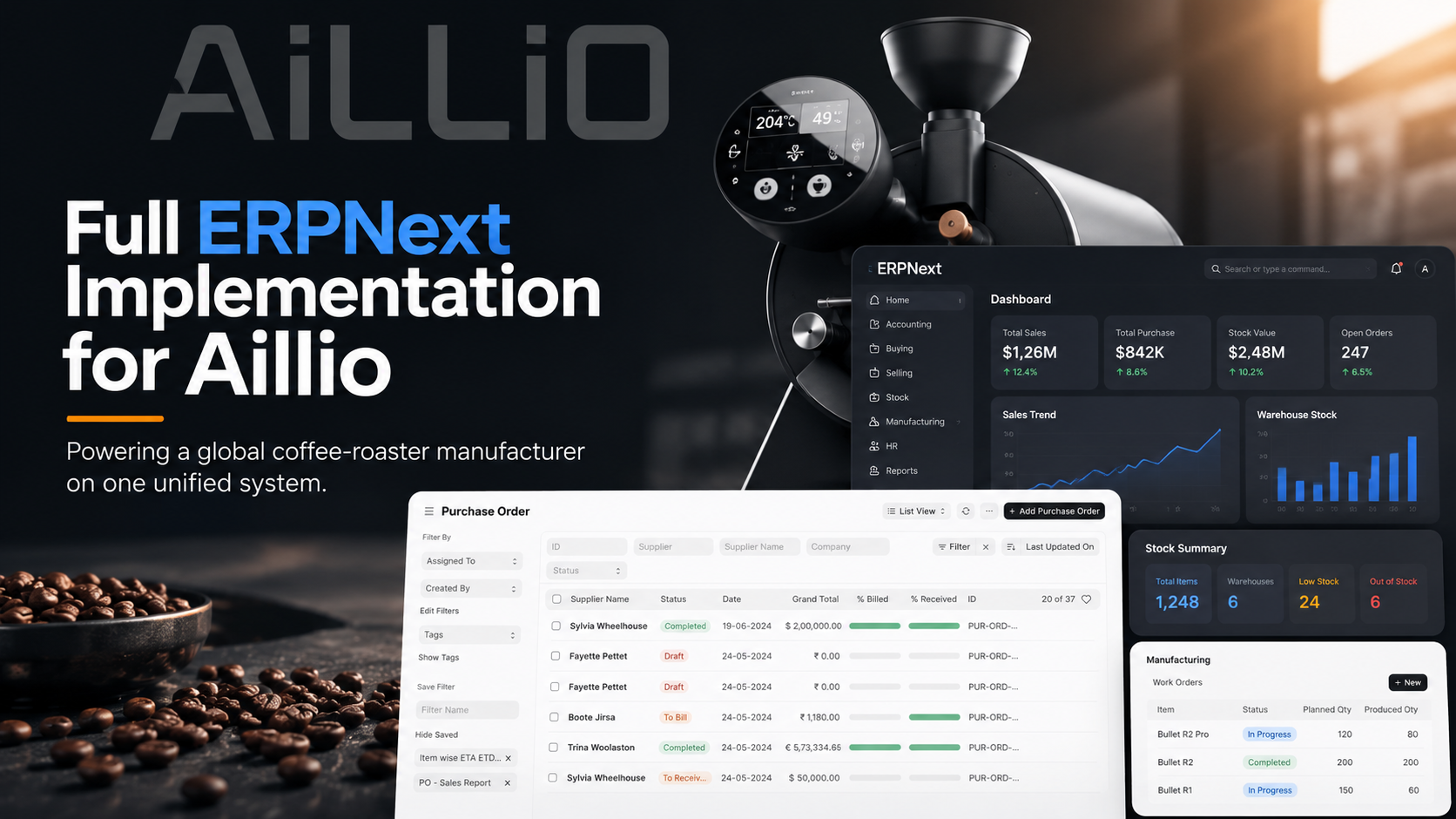
Every sale moves through one pipeline — quotation, sales order, delivery note, and invoice — with live status visible at each stage.
Real-time multi-warehouse stock
Live inventory across every regional warehouse, with batch and serial tracking and automatic reorder points.
Demand-linked manufacturing
Multi-level bills of materials and work orders tie production directly to real sales demand instead of guesswork.
Multi-company, multi-currency accounting
Each region keeps its own books in its own currency, rolling up automatically into one consolidated group statement.
Structured procurement
Supplier records, purchase orders, and material planning turn buying into a planned, visible process instead of a reactive scramble.
Role-based approval workflows
Sales, purchase, and expense documents route automatically by role and value, leaving a full audit trail on every sign-off.
Integrated HR and payroll
Employee records, attendance, leave, and payroll live in the same system and feed straight into accounting.
The guarantees this was built on
- Multi-company data isolationEach regional entity runs on its own company record with its own ledgers and currency, while group reports roll every entity up into one consolidated view.
- Nested bill-of-materials modelingRoaster assemblies are modeled as multi-level BOMs, components into sub-assemblies into finished units, so manufacturing cost and stock consumption stay accurate at every level.
- Real-time stock valuationEvery warehouse transaction updates quantity and valuation immediately, replacing the manual, delayed reconciliation used before.
- Upgrade-safe customizationApproval routing and other custom logic extend the standard ERPNext document flows rather than modify core files, keeping the system on the standard upgrade path.
- Clean legacy migrationItems, customers, suppliers, opening stock, and opening balances were migrated from spreadsheets into validated, deduplicated ERPNext masters.
- Role-scoped permissionsAccess is enforced at the permission layer, so every region and department can only see and act on the data that belongs to it.
Integrations & channels
The outcome
Spreadsheets and disconnected tools were replaced by a single platform running sales, manufacturing, inventory, finance, and HR end to end.
With the full pipeline in one place, order processing runs about 30% faster than before.
Live multi-warehouse stock removed manual reconciliation, bringing stock discrepancies down to near zero.
Linking work orders directly to sales orders cut production lead time to roughly a third of what it was, a 3x improvement.
Per-region books rolling up into consolidated reporting made group financial reporting around 2x more efficient.
Automating manual data entry and approvals reduced day-to-day manual effort by 50 to 60%, cutting related operational costs to roughly a third of their previous level.
Every sales, purchase, and expense sign-off now carries a complete, auditable trail.