From $900 to Nearly $1M in Revenue
A struggling web-based Borehole Log Management system was rebuilt on .NET Core with a multi-tenant architecture, helping the client grow from $900 to nearly $1M in revenue and onboard over 1,300 clients.
What was breaking before this build
Business challenges
- Legacy System with Limited PotentialProject began as a basic web system "far from ready for production," requiring convincing the client to commit to a full rewrite.
- Client Unfamiliarity with Agile/DevOpsClient had no Agile/DevOps experience and needed persuading to move from Trello to Azure DevOps.
- Funding CrisisClient faced a funding crisis; team adapted pace and helped prepare investor documentation/presentations to secure new investment.
Technical challenges
- Multi-Tenant ArchitectureDesigning a flexible architecture to dynamically enable/disable features per tenant on a shared codebase, with proper data isolation and access control.
- Framework MigrationMoving from legacy ASP.NET 4.5 to .NET Core 3.1 and later .NET 7 required refactoring code and adopting new Razor features.
- Complex PDF & Graphical ReportingRendering reports at different scales and generating hatch diagrams required custom rendering/layout logic.
- Geospatial IntegrationIntegrating Google Maps and handling multiple coordinate systems required accurate transformation and representation of geospatial data.
- Microservices with Node.js/Azure FunctionsService orchestration and inter-service communication needed for scalable, fault-tolerant background processing.
How we solved it
Complete Rewrite on .NET Core
Rebuilt the application from scratch on .NET Core 3.1 instead of patching the fragile original.
Multi-Tenant Rearchitecture
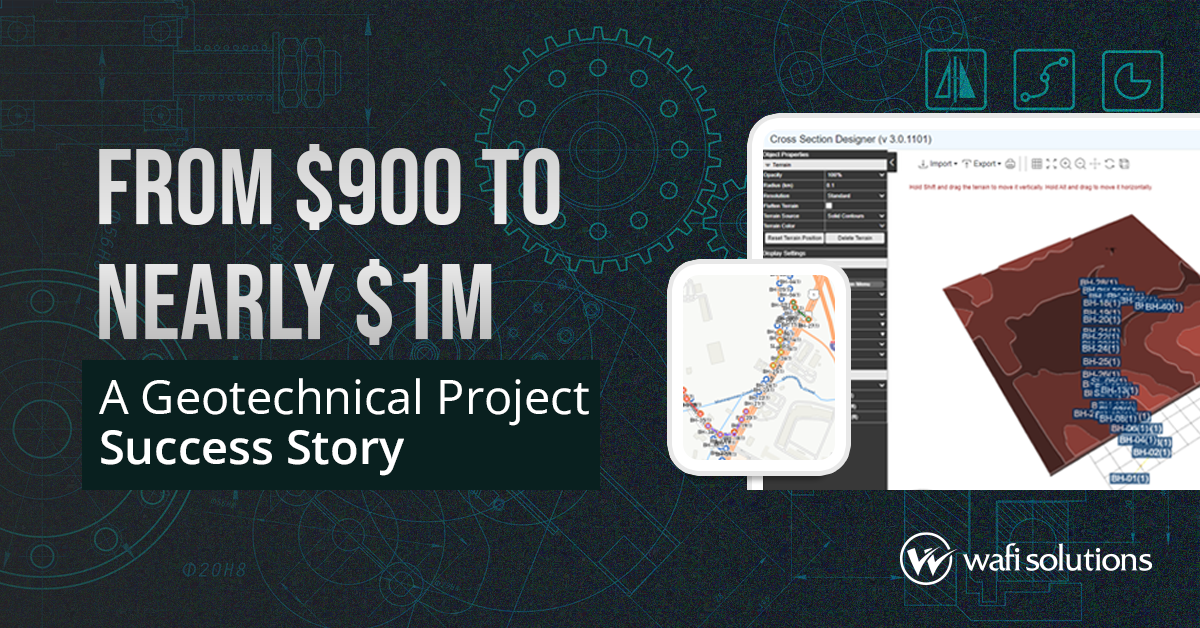
Re-architected as multi-tenant, adding Borehole Data Management, Log Template Design, Report Figures, GIS Map, and Cross-Section tools.
UI/UX Redesign
Delivered a modern, responsive interface.
Agile & DevOps Transition
Moved project management from Trello to Azure DevOps.
Cloud Scaling
Migrated from an Azure VM to Azure App Service with an Azure CI/CD pipeline.
Investor Support
Helped prepare documentation/presentations that secured new investment.
Ongoing Expansion
Added Hatch Patterns, Import/Export, Borehole Log Reports; migrated to .NET 7; built a desktop app.
What the team uses every day
GIS Mapping & Cross-Sections
Interactive GIS maps and cross-section views for borehole data.
Advanced PDF Reporting
Generates borehole log reports with complex hatch diagrams and precise scales.
Import/Export & Data Integration
Imports data (e.g., from Microsoft Access) and exports borehole log reports.
Log Template Designer
Design custom borehole log templates and report figures.
Desktop Application
Companion desktop app alongside the web platform.
The guarantees this was built on
- Multi-Tenant IsolationShared codebase dynamically enables/disables features per tenant while maintaining data isolation and access control.
- Domain-Driven DesignComplex business logic modeled with DDD for clean separation of concerns.
- Microservices via Node.js/Azure FunctionsBackground/bulk-data processing runs as microservices for scalability and fault tolerance.
Integrations & channels
The outcome
Grew client revenue from $900 to nearly $1M
Over 1,300 clients onboarded
Migrated legacy ASP.NET 4.5 to modern multi-tenant